If you've ever hopped on an adult electric motor scooter to zip around a busy city corner or weave through a crowded parking lot, you've probably noticed one thing: not all scooters turn the same way. Some feel tight, responsive-like you can swing a full 180 without breaking a sweat-and others feel like they're dragging their heels, requiring three steps to make a simple turn. As a supplier who's spent years working with these machines, I get asked all the time: "What's the actual turning radius of an adult electric motor scooter?" The answer isn't a one-size-fits-all number, but it's way more important than you might think-especially if you're buying one for daily commutes or weekend errands. Let's break it down, no confusing jargon, just real talk from someone who works with these things every day.
First off, let's define what turning radius actually means, because I've seen a lot of people mix this up. It's the smallest circle a scooter can make without skidding, tipping, or dragging its wheels. If you've ever tried to turn too sharply on a regular bike, you know what that feels like-same idea, just with a motor and battery attached. For adults, this matters way more than it does for kids' scooters, because adult-sized scooters are built for heavier weights and faster speeds, so their turning mechanics are totally different.
Now, let's get to the numbers. Most standard adult electric scooters you'll find on the market (including the ones we carry) have a turning radius between 3.2 feet and 5 feet (about 1 meter to 1.5 meters). Wait, that's a big range-why so much difference? It all boils down to a few key factors: wheelbase length, wheel size, frame design, and even tire type. A longer wheelbase (the distance between the front and back wheels) usually means a wider turning radius. Think of a big truck vs. a small car: the truck needs way more space to turn, right? Same logic here. If a scooter has a wheelbase of 40 inches, it'll have a tighter turn than one with a 50-inch wheelbase.
Wheel size also plays a huge role. Smaller wheels (like 8-inch to 10-inch) tend to turn tighter because they're more agile, while larger wheels (11-inch and up) are smoother for rough roads but need more space to swing around. We've tested this with our 48V 400W Electric Scooter-it has 9-inch wheels and a 3.8-foot turning radius, which is perfect for navigating tight sidewalks or apartment complexes. If you're commuting on busy city streets, a tighter turning radius is less likely to make you clip a fire hydrant or get stuck in a crosswalk.
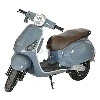
Frame design isn't something most people think about, but it's a game-changer. Some scooters have a "step-through" frame that keeps the center of gravity lower, which makes it easier to lean into turns without tipping. Others have a more aggressive, sporty frame that's built for quick, sharp moves-like the Street Electric Motor Scooters we stock, which are designed for city riding and have a 3.5-foot turning radius. We've had customers tell us they can make a U-turn in a standard parking lane in these, which is a total game-saver when you forget something and have to go back.


Wait, but hold on-those numbers are for ideal conditions, right? If you're riding on wet pavement, loose gravel, or grass, your turning radius might get wider. You can't lean as much on slippery surfaces, so you have to take turns slower and give yourself more space. That's why it's not just about the factory number-you have to adjust how you ride based on the terrain. We always tell our customers: if you're riding on smooth asphalt, you can push the turn limits a little, but if it's wet, go easy. No point in risking a fall just to show off a tight turn.
Now, let's talk about why this actually matters for adults. If you're using a scooter for daily commuting, you're probably stopping at crosswalks, turning onto side streets, and navigating crowds of pedestrians. A scooter with a 5-foot turning radius might work on a wide open road, but if you're trying to turn into a tight apartment driveway, that extra 1.5 feet can feel like a huge gap-one that could make you miss your turn entirely or swerve into someone walking by. On the flip side, a super tight turning radius (under 3 feet) might sound cool, but it can feel unstable at higher speeds, especially for people who are heavier or just learning to ride. That's why we focus on balance with our Electric Scooter For Adults-we test every model to make sure their turning radius is tight enough for city life but stable enough for speeds up to 15-20 mph, which is perfect for most commutes.
I get a lot of questions from people who are new to electric scooters: "Should I get one with the tightest turning radius possible?" Nope, not necessarily. It depends on where you're riding. If you live in a small town with wide streets and big parking lots, a slightly wider turning radius is fine. If you're in a dense city like New York or Chicago, where sidewalks are narrow and corners are tight, a tighter turning radius is non-negotiable. We've had customers switch from a budget scooter with a 5.5-foot turning radius to one of our models with a 3.7-foot radius and say it felt like night and day-they no longer had to get off and push around tight corners, and they saved 5-10 minutes on their commute every day.
Another thing that people overlook: two-wheel vs. three-wheel scooters. Wait, we mostly carry two-wheel models because they're lighter, faster, and easier to store, but some people ask about three-wheel for extra stability. From what we've tested, three-wheel scooters have a slightly wider turning radius because of the extra wheel, so if you're choosing between two types, keep that in mind. Our 2 Wheel Electric Scooter line is the best balance of agility and stability for most adults, with turning radii ranging from 3.2 to 4.8 feet depending on the model. We also have the Two Wheeler Electric Scooter that's built for heavier adults, with a reinforced frame and a turning radius that's still tight enough for daily use.
Let's do a quick real-world test to make this concrete. Last month, we had a customer who worked in downtown Seattle, where the streets are narrow and parking spots are tiny. He was using a cheap scooter he bought online that had a 5.2-foot turning radius, and he kept getting stuck trying to turn into his office parking garage-he'd have to do a three-point turn, which took forever and made him late a few times. He switched to one of our street electric scooters, and he texted us a week later saying he now pulls a U-turn in that garage on the first try. That's the kind of difference a good turning radius makes for real people's daily lives.
Now, let's talk about common myths. I hear all the time: "A smaller turning radius means a better scooter." Not always. Like I said earlier, if the turning radius is too tight, the scooter might feel wobbly at high speeds, which is a safety hazard. We've seen some budget brands cut corners by making the wheelbase super short to get a tight turn, but that makes the scooter unstable when you're going 18 mph. Our suppliers design their scooters with safety in mind first-so the turning radius is tight enough for maneuverability, but the frame and wheels are built to keep you stable when you lean into a turn. That's why we only stock models we've tested ourselves, no cheap knockoffs.
Another myth: turning radius is only for cornering. It's also about how easy it is to park your scooter. If you're trying to squeeze it next to a bike rack or store it in a small closet, a tighter turning radius means you can maneuver it into tight spots without knocking things over. We had a customer who lives in a studio apartment with a tiny entryway-she said her old scooter was so hard to turn that she'd scratch her walls every time she brought it inside. Our model with a 3.5-foot turning radius? She said she parks it in her entryway no problem now, no scratches, no stress.
So, what should you look for when shopping for an adult electric scooter based on turning radius? First, think about where you'll ride it most. If it's city commuting, aim for a turning radius under 4 feet. If it's suburban errands or wide sidewalks, 4 to 5 feet is fine. Second, check the specs, but also read real customer reviews. A lot of brands list the turning radius on their site, but some fudge the numbers-our customers consistently say our numbers match what they feel when riding. Third, test it if you can. If you're buying in person, take it for a spin around a empty parking lot and see how it feels when you turn. If you're buying online, look for videos or reviews from people who have similar riding needs to you.
Here's the thing: at the end of the day, the turning radius of an adult electric motor scooter isn't just a number on a spec sheet. It's about how easy it is to get where you're going, how safe you feel riding, and whether your scooter works with your daily life. As a supplier, we don't just sell scooters-we want to help people find the one that fits their lifestyle. That's why we carry a range of models, from budget-friendly options to higher-end street models, all with different turning radii to match different needs.
If you're in the market for a new adult electric motor scooter and want to figure out the right turning radius for you, feel free to reach out and chat. We can walk you through our different models, talk about how their turning radii work for specific riding scenarios, and help you pick one that's perfect for your needs. Whether you're commuting to work, running errands around town, or just cruising on weekends, we've got options that'll fit what you need. Don't settle for a scooter that's too hard to turn-your daily rides will be way more enjoyable when you have one that handles like a dream.